Seaweed disease: Ice-ice On Seaweed

Seaweed disease: Ice-ice On Seaweed

Cause: Environmental factors and several types of bacteria: Pseudoalteromonas gracilis, Pseudomonas spp .. and Vibrio spp.

Bio – Ecology Pathogens:
• The case of ice-ice on seaweed farming is triggered by fluctuations in water quality parameters are extreme (salinity, water temperature, dissolved organic matter and sunlight intensity).
• Other triggers are insect like fish baronang, green turtles, sea urchins and starfish cause injury to the thallus, so easily infected by microorganisms.
• In the state of stress, sea grass will release organic substances that cause thallus slimy and stimulate the bacteria grow abundantly in the vicinity.
• Growth of bacteria on the thallus will cause the thallus becomes white and fragile. Furthermore, easily broken, and the soft tissue that characterize the ice-ice disease.
• The spread of this disease can occur vertically (from seed) or horizontally through the mediation of water.

Clinical symptoms:
• The disease is characterized by the emergence of spots / red spots on some of the old thallus gradually became pale yellow and finally fade to white. Thallus become brittle and easily broken.
• Symptoms are shown slow growth. the color change becomes pale and at several branches and rotting thallus to be white.

Diagnosis:
• visual and microbiological observations.

Control:
• The use of quality seeds is a very important way to control ice-ice disease.
• Disinfection of seedlings can be dipped in the solution by PK (potassium permanganate) with a dose of 20 PPM
• Selection of farms that meet the optimum requirements for growth of seaweed.
• Application of cultivation techniques adapted to aquatic environments
• Noting the season in relation to cultivation techniques that would be applied.
source: Ministry of Maritime Affairs and Fisheries of Indonesia, Directorate General of Aquaculture, Fish and Environmental Health Directorate, 2010
Fish Disease: vibriosis in shrimp

Fish Disease: vibriosis in shrimp

Cause: Vibrio harveyii, V. alginolyticus, V. parahaemolyticus. etc..

Bio – Ecology Pathogens
• vibriosis in shrimp larvae commonly as secondary infection, especially when under stress and weak.
• Bacterial infections are usually associated with stress conditions due to: high density, malnutrition, poor handling. parasitic infections, high organic matter, low oxygen. poor water quality. extreme fluctuations in water temperature. etc..
• The attack is acute, and if environmental conditions continue to decline, which caused the death can reach 100%. particularly in post-larvae or juvenile stage.

Clinical symptoms:
• Body of shrimp look dull and dirty.
• decreased appetite, damage to the legs and gills, gill or brownish color.
• Types of Vibrio spp. which generally attacks the larvae glow shrimp and prawn disease disease called glow (luminescent vibriosis).
• Shrimp affected showed symptoms of necrosis, the condition of the body is weak, slow swim, appetite loss, red spots (red discoloration) on the pleopod and abdominal as well as visible light at night
• Shrimp vibriosis affected leg will show the pool (pleopoda) and the foot path (pereiopoda) shows melanisasi.
• Shrimp are dying often swim to the surface or edge of the pond embankment.

Diagnosis:
• Isolation and identification of bacteria through bio-chemical tests.

Control:
• Disinfection of aquaculture facilities before and during the maintenance process shrimp
• Giving immunostimulan element (eg addition of
vitamin C in feed) are routinely during maintenance
• Avoiding the occurrence of stress (physical, chemical, biological)
• shrimp health management in an integrated manner

source: Ministry of Maritime Affairs and Fisheries of Indonesia, Directorate General of Aquaculture, Fish and Environmental Health Directorate, 2010

fish disease: vibriosis in fish

fish disease: vibriosis in fish
Cause: Vibrio alginolyticus, V. parahaemolyticus, V. vulnificus, V. ordalii, etc..

Bio – Ecology Pathogens
• Bacteria in sea water ecosystems, and vibirosis still
is a major problem for marine fish farming industry.
• The case of vibriosis can occur throughout the year, but commonly associated with stress due to handling, high density or changes in extreme weather.
• The death rate of fish at the larval stage up to the size
fingerlings are attacked by the bacteria may reach 80-90%.

Clinical Symptoms:
• Weak, loss of appetite, swim in the water surface, and opaque color.
• Inflammation of the rectum, gills, mouth, base of fin, followed by bleeding and blisters on the surface of the body, as well as open wounds.
• In advanced infection of bleeding in the mouth and base of fins, excess mucus in the gills, dropsy, pale liver color. and eyes swollen.

Diagnosis
• Isolation and identification of bacteria through a bio-chemical tests

Control:
• Disinfection of aquaculture facilities before and during the maintenance of fish
• Giving immunostimulan element (eg addition of
vitamin C in feed) are routinely during maintenance
• Avoiding the occurrence of stress (physical, chemical, biological)
• Management of fish health in an integrated (fish, environment and pathogens)
• Limit and / or regulate feeding and mixing of feed with drugs (medicated feed and feed restriction)
• Conducting anti-vibriosis vaccination.
source: Ministry of Maritime Affairs and Fisheries of Indonesia, Directorate General of Aquaculture, Fish and Environmental Health Directorate, 2010

fish disease: Enteric Septicemia of Catfish (ESC)

fish disease: Enteric Septicemia of Catfish (ESC)

Cause: Edwarsiella ictaluri
Bio-Ecology Pathogens:
• rod-shaped bacteria, gram-negative character moves with the aid of flagella. does not form spores or capsules and are facultative anaerobes.
• Originally known to only infect fish cannel catfish, but the latter is known to infect other fish species such as catfish, catfish, and eel. Experimentally, several types of fish such as trout, tilapia, salmon and ornamental fish can also be infected with this bacteria.
• Transmission of horizontally ie contact between the host or through the water.
• Case ESC generally occurs when water temperatures are relatively warm (22-28 degrees Celsius), but at water temperatures below 20 degrees Celsius or above 30 degrees centigrade, this bacteria is decreased malignancy.

Clinical Symptoms
• Weak, loss of appetite. color pale gills, sometimes protruding eyes and / or abdominal swelling (dropsy)
• Often, too, found the existence of petechiae (red spots) on the body part that is not pigmented (under the chin, stomach or at the base of the fin)
• Swim in the water or the pool with his head pointing up
• Before dying, the fish usually swim like a spastic and / or swim like a spiral spin
• There are white patches on internal organs (liver, spleen, kidney, d1l.)

Diagnosis
• Isolation and identification of bacteria through bio-chemical tests.
• Detection of bacterial genes by polymerase chain reaction (PCR)

Control:
• Avoiding the occurrence of stress (physical, chemical, biological)
• Improve overall water quality, particularly reducing the levels of dissolved organic material and / or increase the frequency of replacement of new water
• Management of fish health in an integrated (fish, environment and pathogens)
• Limit and / or regulate feeding and mixing of feed with drugs (medicated feed and feed restriction)
• Conducting anti-Edwardsiella ictaluri vaccine.

source: Ministry of Maritime Affairs and Fisheries of Indonesia, Directorate General of Aquaculture, Fish and Environmental Health Directorate, 2010

Fish Disease: Edwarsiellosis

Fish Disease: Edwarsiellosis

Cause: Edwarsiella tarda

Bio-Ecology Pathogens:
• curved rod-shaped bacteria, gram-negative character moves with the aid of flagella, do not form spores or capsules, are facultative anaerobes, and able to produce H2S.
• Found in freshwater environments and sea water, infecting several species of fish include: salmon, catfish, carp, tilapia. etc..
• Transmission of horizontally ie contact between host one with another host or through water.
• Generally occurs at a relatively high water temperature (± 30 degrees Celsius) and high organic matter content.
• The death rate depends on environmental conditions, in very poor conditions can lead to death by 50%.

Clinical Symptoms:
• In mild infections, revealing only minor injuries.
• As the development of more advanced disease, purulent wound developed in the ribs and stomach muscles.

• Pale, bloated stomach containing a yellowish liquid or redness, bleeding of the rectum and / or depressed into the anus, and eyes faded.
• Further development, injuries (cavities) experience swelling and if scratched will smell of H2S gas.

Diagnosis:
• Isolation and identification of bacteria through bio-chemical tests.
• Detection of bacterial genes by polymerase chain reaction (PCR)

Control:
• Avoiding the occurrence of stress (physical, chemical, biological)
• Improve overall water quality, particularly reducing the levels of dissolved organic material and / or increase the frequency of replacement of new water
• Management of fish health in an integrated (fish, environment and pathogens)
• Limit and / or regulate feeding and mixing of feed with drugs (medicated feed and feed restriction)
• Conducting anti-Edwardsiella tarda vaccination.

source: Ministry of Maritime Affairs and Fisheries of Indonesia, Directorate General of Aquaculture, Fish and Environmental Health Directorate, 2010

Microsporidiasis (Cotton Shrimp Disease)

Microsporidiasis (Cotton Shrimp Disease)

Cause: The Microsporidia of the genera Thelohania, Nosema and Peistophora

Bio – Ecology Pathogens
• Named as cotton shrimp disease and / or shrimp milk.
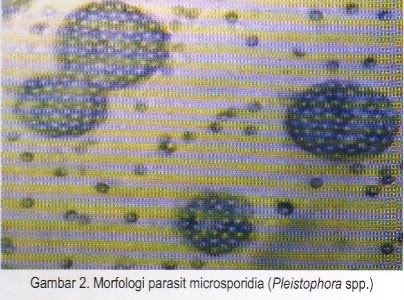
• Having more than 8 spores in each capsule
• Virtually all penaeid shrimp species was reported the least susceptible to infection one type of parasite microsporidia group, although there are indications of specific local

• low pathogenicity, prevalence rates in a population generally not more than 5% and the resulting mortality was also relatively low

Clinical symptoms:
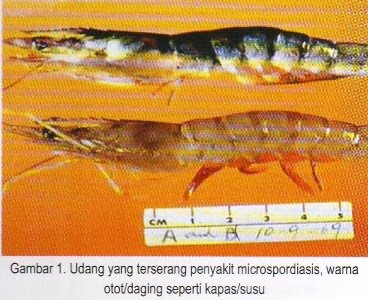
• Parts of the body of infected shrimp white milk and more soft
• white spores spread on the meat / muscle (internal parasites)
• Shrimp weak, easy to stress, decreased appetite, making it easy prey to predators sluggish, and easily die after handling (handling)

Diagnosis:
• Visual observation of behavior and clinical symptoms are quite clear
• Microscopic observation to see the morphology of microsporidia by making preparations for review of target organ infection. The observation that more clear on the characteristics of spores required specific staining.

Control:
• disinfection, drying of pond bottom and water sources that are free of microsporidia
• Shrimp are infected immediately destroyed, in order to reduce the potential for horizontal transmission
• To cut the parasite’s life cycle, avoiding the feeding of trash fish infected with microsporidia
• No chemicals are effective for preventing and / or treat diseases microsporidiasis.

source : Kementerian Kelautan dan Perikanan, Dirjen. Perikanan Budidaya, 2010